From Idea to MVP: A Step-by-Step Product Journey
Mobrio Studio
Your trusted partner in refactoring and scaling code
“MVP” is one of the most misunderstood terms in product building. Some see it as a rushed prototype. Others think it means shipping poor-quality software. Both assumptions are wrong.
An MVP is not about doing less.
It’s about doing the right things first without sabotaging your future.
Let us walk through this journey in a systematic manner and get a few reality checks which are needed for a product to succeed.
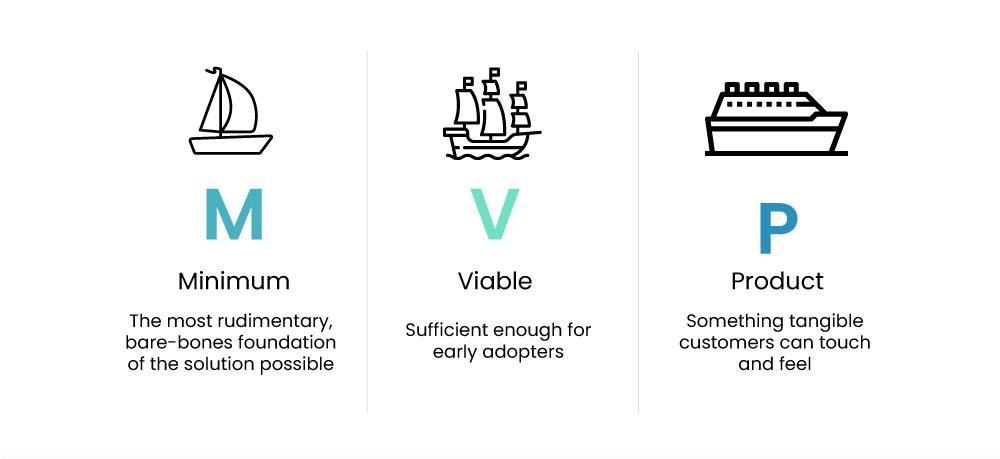
MVP: The literal meaning
Step 0: Start With the Idea Write It Down
Every product begins the same way : An Idea.
Before technology, frameworks, or timelines, the first step is clarity.
Ask yourself:
- •What problem am I solving?
- •Who is the user?
- •How does the user interact with the product?
- •What data is created, stored, or consumed?
This stage is not about how you build it.
It’s about how the product works from a user’s perspective. It's about how valid your product is going to be for the user.
Only after this is clear ,does the technical thinking make sense.
Step 1: Technical Feasibility Can This Be Built?
After defining how the product should work, the next question is simple:
Is this technically feasible with today’s technology?
This is where experienced engineering input matters.
At this stage, one must evaluate:
- •Technical complexity
- •Time-to-build
- •Constraints and trade-offs
- •Technology choices (native, Flutter, Kotlin Multiplatform, backend stack, etc.)
This step prevents founders from overcommitting to ideas that look simple on paper but are extremely complex in execution.
Step 2: Proof of Concept (PoC) — Validate the Idea
A Proof of Concept (PoC) exists to answer one question:
Does this idea work at all?
A PoC:
- •Runs locally
- •Is not production-ready
- •Is not meant for users
- •Exists only to validate feasibility
Today, PoCs can be built quickly using AI tools and rapid prototyping. You don’t need heavy engineering investment here.
But the most important thing is to remember that a PoC is not an MVP.
If it can’t go to users, investors, or real environments it’s still just a PoC.
Step 3: What an MVP Actually Is (And what it Isn’t)
MVP = Minimum Viable Product
An MVP is:
- •The first version of your product that can go to users
- •Is Production-capable
- •Stable enough to collect real feedback
- •Focused only on essential features
An MVP is not:
- •A toy app
- •A demo that only works locally
- •A dumping ground for all features
Example: MVP for an E-Commerce App
Let us consider a simple example for mvp of an E-Commerce app
A full e-commerce platform may include:
- •Search
- •Recommendations
- •Wishlist
- •Reviews
- •Offers
- •Analytics dashboards
- •And more
But, An MVP may include only:
- •Homepage
- •Product details
- •Checkout
Nothing more.
If a feature is not essential for the user to use the product, it does not belong in the MVP.
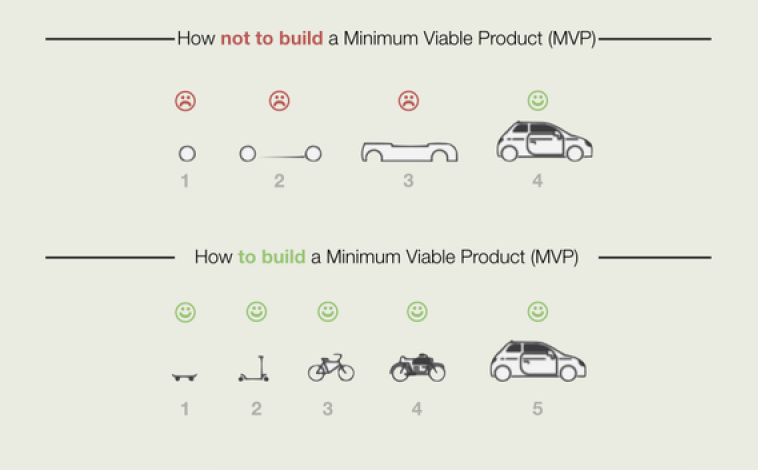
What to do and what NOT to do for building an MVP
The Biggest MVP Myth: “We’ll Clean It Up Later”
Many teams believe:
“We’ll build fast now and refactor later.”
This is how technical debt becomes a technical disaster.
What often happens:
- •Speed is achieved by ignoring architecture
- •Code quality is sacrificed
- •No tests, no structure, no standards
- •When the product scales, everything breaks
- •Teams are forced to rewrite from scratch
That rewrite would cost you more than building it right the first time.
MVP Is About Intelligent Choices
The most important thing to keep in mind while creating an MVP is to make “intelligent choices”.
Intelligent choices is a term we can use to refer the choices one makes while deciding what features to keep and what not
This might just seem like an easy statement, but the power to reject some unnecessary features is really a difficult move.
MVP success depends on decision-making, not coding speed.
Every feature must answer:
“Does this feature really need to be kept in the mvp?”
If the answer is no, remove it.
Successful products choose restraint.
We guide teams with experience, but the final decision always belongs to the founders.
MVP and Product-Market Fit (PMF)
You cannot reach PMF without users and
You cannot get users without shipping.
Research alone doesn’t create PMF, real usage does.
An MVP exists to:
- •Go to market quickly
- •Gather real feedback
- •Validate assumptions
- •Enable iteration
If you keep adding features endlessly, you delay moving forward and delay success.
Where AI and “Vibe Coding” Fit In
There exists literally nothing technical in today's day without the involvement of AI
And AI in building MVPs uses Vibe Coding
AI tools are powerful but they follow the standards you set.
High standards , AI generates clean code
Low standards , AI produces garbage faster
No doubt, AI is excellent for PoCs, Accelerating development and Assisting experienced teams
But
AI cannot replace Architecture decisions, Code quality judgment, Long-term maintainability thinking
A strong codebase ensures AI works with you not against you.
The Roadmap: Idea → MVP (At a Glance)
- •Write down the idea
- •Define user interaction
- •Validate technical feasibility
- •Build a PoC (optional, fast)
- •Decide MVP scope intelligently
- •Build production-ready MVP
- •Go to market
- •Learn, iterate, scale
Building an MVP is not about building less.
It’s about building right.
Many products fail not because the idea was bad but because the MVP was rushed, poorly architected, or built without thinking about scale.
At Mobrio Studio, we help founders:
- •Define what truly belongs in an MVP
- •Move fast without sacrificing code quality
- •Build production-ready foundations from day one
- •Avoid expensive rewrites after product-market fit
If you’re turning an idea into your first real product or adding features to an existing one we’d love to help.
An MVP should validate your idea not create technical debt.
Mobrio Studio builds MVPs that scale when they succeed.
Because success shouldn’t punish you for moving fast.
Let’s discuss your product
Talk to us about your MVP or next feature
Schedule a free discovery call here: info@mobriostudio